THE STRATEGOGAME FIELD GUIDE
Stratego Pieces and Ranks
Stratego pieces form a forty-piece army per player: thirty-three movable soldiers, six Bombs and one Flag. This reference answers the number-of-pieces and piece-values questions without selling replacements. The main table uses Marshal 10 down to Spy 1, while a second column translates older reversed numbering. Each move and battle example is tied to a named piece so that a different printed number does not silently reverse the result.
There are twelve piece types, forty pieces per player and eighty on a full classic board. Bombs and Flags are stationary identities, not ranks 11 and 0 to compare in ordinary fights.
- How many pieces are in one classic army?
The forty-piece format has twelve types: thirty-three mobile soldiers, six Bombs and one Flag per player. Two complete armies total eighty pieces. The number of types is not the number of pieces on one side.
- Is the Marshal always numbered 10?
This board uses Marshal 10 as the strongest officer and Spy 1 as the weakest ordinary fighter. Some older sets reverse the officer numbers. Match the piece names and edition before comparing printed numbers across two sets.
Stratego pieces: full list, counts and movement
Read the Count column as copies in one army, not the total in both colors. Each side has four Sergeants; five would produce an incorrect forty-one-piece army. A Scout’s rank is 2 in this version, but it has the unique long-distance move. Every other mobile type moves one orthogonal square regardless of rank.
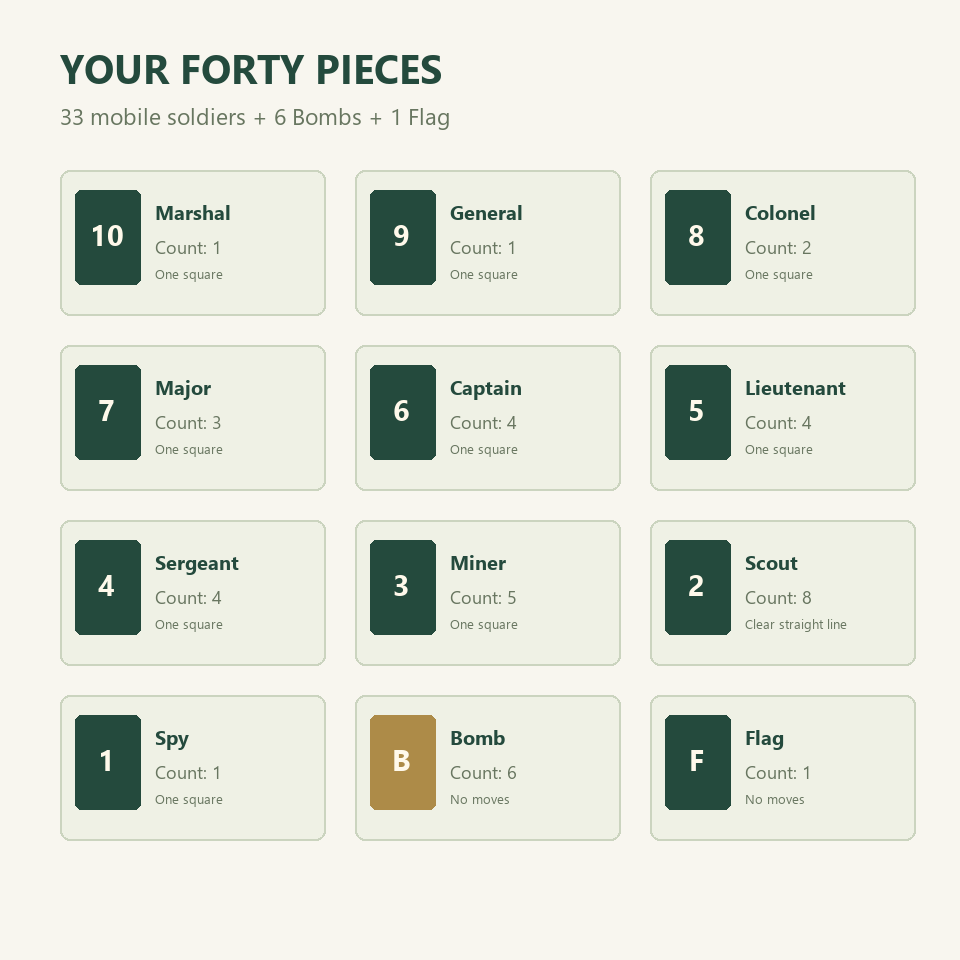
| Piece | Modern rank | Older rank | Count | Move | Battle note |
|---|---|---|---|---|---|
| Marshal | 10 | 1 | 1 | One orthogonal square | Higher beats lower; equal removes both |
| General | 9 | 2 | 1 | One orthogonal square | Higher beats lower; equal removes both |
| Colonel | 8 | 3 | 2 | One orthogonal square | Higher beats lower; equal removes both |
| Major | 7 | 4 | 3 | One orthogonal square | Higher beats lower; equal removes both |
| Captain | 6 | 5 | 4 | One orthogonal square | Higher beats lower; equal removes both |
| Lieutenant | 5 | 6 | 4 | One orthogonal square | Higher beats lower; equal removes both |
| Sergeant | 4 | 7 | 4 | One orthogonal square | Higher beats lower; equal removes both |
| Miner | 3 | 8 | 5 | One orthogonal square | Removes Bomb; otherwise normal rank |
| Scout | 2 | 9 | 8 | Any clear straight distance | Can attack at end of a clear line |
| Spy | 1 | S | 1 | One orthogonal square | Beats Marshal only when attacking |
| Bomb | — | — | 6 | None | Only an attacking Miner removes it |
| Flag | — | — | 1 | None | Any legal attacker captures it |
| Total | 12 types | Same named roles | 40 | 33 movable; 7 stationary | 80 pieces across both armies |
Piece values: strength is not an end-of-game score
Capturing pieces does not award a fixed score that decides the winner. Capturing a Flag wins even if your opponent has more soldiers. A Marshal has the highest ordinary fighting strength, but a Miner may be more useful in a position where a Bomb blocks the last approach. A Spy’s special attack can matter more than its position at the bottom of the usual rank order.
It helps to distinguish three meanings of value: printed rank for battle comparison, remaining count for information, and positional usefulness for your current plan. Only the first is a fixed rule. Any numerical weights used by a computer opponent are evaluation choices, not official material points you should add up to declare victory.
Marshal through Sergeant: ordinary rank comparisons
Marshal, General, Colonel, Major, Captain, Lieutenant and Sergeant occupy ranks 10 through 4 in descending order. Higher beats lower in an ordinary encounter, independent of who initiates it. A Captain 6 attacking a Major 7 loses and does not dislodge the Major. A Captain attacking a Captain removes both, so no Captain takes over that square.
Those officers are still subject to the special cases: none can remove a Bomb by force, and the Marshal can fall to a Spy that attacks first. Greater strength also does not permit a longer move, a diagonal approach or an attack through a friendly blocker. Rank is checked only after a legal attack reaches an enemy destination.
Miner, Scout and Spy: low ranks with distinct jobs
The Miner 3 moves one square and is the only classic soldier that removes a Bomb by attacking it. It can capture a Scout or Spy in an ordinary fight, but loses to higher officers. The Scout 2 moves any clear straight distance, may attack at the end, and cannot turn during that move. A long move reveals its identity even without combat.
The Spy 1 moves one square. Its special victory is narrowly defined: it must attack the Marshal. A Marshal attacking it wins, and a General still defeats it in either direction. Two Spies remove each other. These exceptions make preserving a specialist useful for a specific future task rather than treating all low ranks as interchangeable expendable pieces.
Bomb and Flag: why the marks are not ordinary numbers
The six Bombs and single Flag stay fixed after setup. A Bomb defeats an attacking non-Miner and stays on its own square; an attacking Miner removes it and takes its square. A Flag loses to any legal attacking soldier and ends the match. Because neither type can move, they cannot initiate a battle against one another.
Our internal engine stores these types with special numeric codes, but those codes are implementation details rather than player-facing strength ranks. Read the Bomb symbol and Flag symbol by name. Calling a Bomb the eleventh strongest soldier is misleading because it cannot chase anything and a rank-3 Miner can remove it.
Check a physical set without mixing editions
Sort one color by name and compare its inventory with the table before assuming pieces are missing. Alternate figure designs, anniversary extras or optional specialists may be supplied without belonging in the standard forty. If a leaflet describes a Spotter, Infiltrator, cards or magical abilities, use that edition’s instructions to decide what is active.
For a replacement search, match the manufacturer, edition and numbering direction first; artwork alone is not enough. This page provides identification information and no purchase buttons. For actual movement disputes continue to the rules reference, and for the role of surviving pieces in a match use the strategy guide.
Sources and edition notes
The rule facts below were checked against these references. The examples, formations, diagrams, video and printable explanation on this site were written for this guide.
- Jumbo: Original / 65th Anniversary rules ↗Classic forty-piece army, movement, battles and the optional Battle Cards edition. Our examples are independently written.
- Strategus: both rank-number systems ↗A useful name-by-name comparison of the older and newer numbering directions.
- PlayMonster: Stratego Original rules ↗Publisher reference for Original and its edition-specific additions. Extra box contents are not automatically part of a classic army.
A complete match teaches more than memorizing every hidden possibility.
Go to the board →